
IPTV is no longer just a way to watch TV channels. For many users, the television has become the main home entertainment hub, bringing together movies, series, sports broadcasts, YouTube, and streaming platforms in one place. Still, there is one issue that often appears after adding new equipment: a clean TV area can quickly turn into a visible cluster of cables, power adapters, and devices. The good news is that a modern IPTV setup can be arranged so that it stays almost invisible while retaining its full functionality and supports practical minimalist TV setup ideas for everyday living.
Why Minimalism Matters in the TV Area
Modern interiors are increasingly built around the idea that less is more. The TV is no longer necessarily the centerpiece of the room, and many users want their space to feel cleaner, lighter, and more visually balanced. This is especially important in studio apartments, compact living rooms, and bedrooms, where exposed wires immediately stand out. For many households, this is part of creating a clean living room setup where technology stays useful but visually quiet.
At the same time, an IPTV system usually includes several components: a TV, a media player or set-top box, a router, power cables, and an internet connection. Without planning the layout in advance, even premium equipment can look messy. That is why TV cable management ideas are best considered before the installation is complete.
Where to Place the Set-Top Box
A common mistake is placing the set-top box directly under the TV on an open shelf. It is simple, but it is rarely the most elegant solution. If you are wondering how to hide a set top box, start with thoughtful placement before connecting every cable.
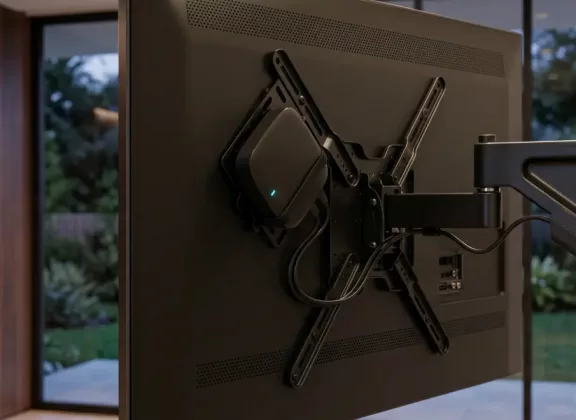
Most modern IPTV set-top boxes are compact enough to be mounted behind the TV using dedicated brackets or adhesive mounting pads. Compact devices running Android TV or Google TV work especially well in this setup because, after the initial configuration, they usually do not require frequent physical access. This kind of hide streaming box setup is ideal when you want hidden media devices to stay out of sight.
If your TV is mounted on the wall, the set-top box can be fixed behind the screen so that only the display remains visible. This approach is especially popular in minimalist interiors. It is also one of the simplest TV box placement ideas for a clean TV wall setup.
Another option is to place the device inside a TV cabinet or wall-mounted console. The only important condition is proper ventilation: the equipment should have enough space around it so it does not overheat during long viewing sessions. A floating TV unit can also hide the device while keeping the installation visually light.
How to Hide Cables Without Renovation
Most visual clutter comes not from the devices themselves, but from the cables. Power cords, HDMI cables, Ethernet lines, and chargers can quickly create a tangled, untidy look. That is why many users look for simple ways to hide TV cables and wires without redesigning the whole room.
Fortunately, you do not need a full renovation to solve this. Wall-mounted cable channels can be installed and painted the same color as the wall. Once in place, they become almost unnoticeable. These cable covers for TV are among the most accessible cable management solutions for finished interiors.
If the TV stands on a cabinet, textile or plastic cable organizers can help group wires together. Instead of several loose cables hanging in different directions, you get one neat line. This helps conceal wires behind TV furniture and creates a cleaner hidden wires TV effect.
For IPTV users, wireless connections are also worth considering whenever possible. Modern set-top boxes support Wi-Fi, so you can avoid using an Ethernet cable if the signal is strong and stable enough.
Which Set-Top Box Fits Best in a Minimalist Interior?
Not every device is equally convenient for a clean setup. Some models require external drives, extra adapters, or multiple additional connections.
Devices based on Linux, as well as modern solutions running Android TV and Google TV, are often more compact because many functions are already built into the system. They provide access to IPTV, VoD services, YouTube, and other apps through a single interface without requiring lots of extra accessories. This makes them suitable for a minimal TV installation setup and for a smart home TV setup where every device should fit neatly into the overall ecosystem.
When choosing a device, pay attention not only to performance and features, but also to the body size, port layout, and power connection. These small details often determine whether the entire TV area will look clean and well organized.
Minimalism Starts with the Interface
Even if all hardware is perfectly hidden, the setup will not feel truly minimal if the screen itself opens to a crowded menu. Modern platforms allow users to customize the home screen so that only the apps and channels they actually need are displayed.
Removing unnecessary shortcuts, creating favorites lists, and setting up personal profiles make the IPTV experience feel as organized as the physical TV area.
This is especially useful in families where several people share one television. Personalized profiles let each viewer see the content that matters to them, without overloaded menus or endless recommendation feeds.
Creating a neat IPTV zone does not require major spending or complex installation work. In most cases, thoughtful placement of the set-top box, tidy cable management, and the features of modern platforms are enough. Compact devices based on Android TV, Google TV, and Linux help keep the interior clean and modern without giving up functionality. For a wall mounted TV setup, basic wall mounted TV cable management — or even the option to hide cables behind wall TV — can make the whole area look especially polished.
As a result, the TV becomes a natural part of the room rather than the technical center of it. This is exactly what modern minimalism is about: maximum capability with minimum visual noise, an aesthetic TV wall, and technology that works quietly in the background.
