
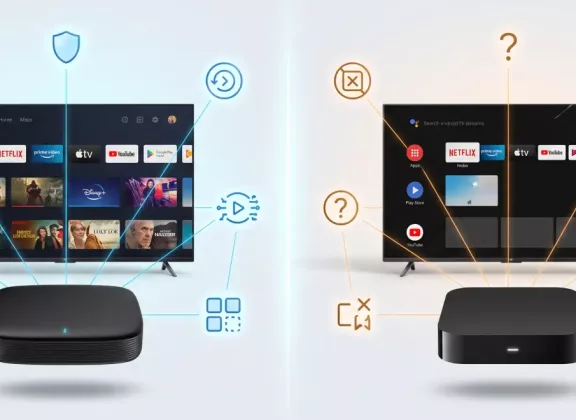
When choosing an Android TV box, buyers often focus on processor performance, RAM, storage capacity, Wi-Fi standards, and support for 4K video. These specifications are important, but they do not always tell you how the device will behave in everyday use.
Two media players with very similar hardware can provide completely different experiences. One may offer stable access to Google Play, work correctly with popular streaming applications, and receive software updates. Another may require manual APK installation, limit playback quality, or encounter compatibility problems after an app update.
In many cases, the difference comes down to certification. Understanding what an Android TV box certification actually means helps buyers evaluate a device beyond its technical specifications and avoid unpleasant surprises after purchase.
What Certification Means for an Android TV Device
A certified Android TV or Google TV device is built to comply with requirements established for the official Android ecosystem.
One of the key elements is Google Play Protect certification. Google explains that certified devices have passed Android compatibility testing and are permitted to include licensed Google applications. Devices that are not Play Protect certified may not work correctly with Google services and can experience problems with application or system updates.
This distinction matters because the phrase “Android TV box” is sometimes used very broadly.
Some inexpensive media players run modified versions of standard Android originally designed for smartphones or tablets. Manufacturers can adapt such software to a television interface, but this does not automatically make the device equivalent to an officially certified Android TV or Google TV product.
From the outside, both devices may display familiar Android icons. Their actual compatibility with Google services, TV applications, and protected streaming content can nevertheless be very different.
Why Google Play Certification Affects Everyday Use
For most users, one of the main advantages of a certified Android TV box is reliable access to applications designed specifically for television screens.
The Android TV version of Google Play distributes apps optimized for remote controls, large displays, and TV navigation. This is different from simply installing a smartphone APK on a television device.
On an uncertified box, users may still find a Play Store application or other Google services. Their presence alone, however, does not prove that the hardware is officially certified.
When applications are unavailable through the TV store, users often turn to sideloading. Manually installing APK files can extend the functionality of a device, but it also introduces additional uncertainty. A mobile application may not support remote-control navigation, may display incorrectly on a television, or may stop working after a future update.
For technically experienced users, these limitations may be manageable. For someone looking for a media player that simply works after setup, official compatibility usually provides a more predictable experience.
A 4K Label Does Not Guarantee 4K Streaming
One of the most common misunderstandings concerns video resolution.
A device can support 4K output through HDMI and still be unable to stream a particular subscription service in 4K or even HD.
The reason is that commercial streaming platforms use digital rights management technologies to protect licensed content. On Android-based devices, Widevine is one of the most widely used DRM systems.
For example, Netflix requires appropriate Widevine security support for HD playback on Android devices. A box operating only with a lower DRM security level may technically decode 4K video files but still receive a lower-resolution Netflix stream.
This is why specifications such as “4K media player” or “4K Android box” should not be interpreted as a universal guarantee of 4K playback across all streaming services.
There is also an important distinction between Google certification and certification by individual content platforms. A device can be Google certified and support Widevine L1 while still requiring separate approval from Netflix or another streaming provider to access certain HD, 4K, HDR, or premium playback modes.
The practical rule is simple: if a particular streaming service is important to you, check support for the exact device model.
Certification Can Improve Long-Term Software Compatibility
An Android TV box is rarely purchased for just a few months. Most users expect it to remain useful for several years.
During that time, streaming applications, Google services, security requirements, and Android itself continue to evolve.
Certified devices operate within Google’s compatibility framework, which gives manufacturers a clearer foundation for supporting current applications and future platform requirements. This does not mean that every certified media player will receive Android upgrades indefinitely. Software support policies still depend on the manufacturer.
However, certification reduces the risk that the device starts with an Android implementation that is already outside the official compatibility ecosystem.
With uncertified boxes, software maintenance can depend heavily on the individual vendor. Some manufacturers provide regular firmware updates, while others release the hardware with a customized Android build and offer little or no long-term support.
The difference may not be obvious on the first day of use. It often becomes visible months or years later, when applications begin requiring newer APIs, updated DRM components, or more recent security standards.
Security Is Part of the Certification Question
A modern TV box is connected to far more than a television.
Users may sign in to Google accounts, YouTube, IPTV services, subscription platforms, and other applications containing personal information. This makes software security relevant even on a device primarily used for entertainment.
Google Play Protect checks applications for potentially harmful behavior and can identify or block certain malicious software. Certified devices participate in this broader security ecosystem.
An uncertified box is not automatically unsafe, and certification does not eliminate every possible security risk. The practical distinction is that a certified device operates within defined compatibility and security mechanisms, while the security of an uncertified product depends much more heavily on the manufacturer, firmware source, and applications installed by the user.
This becomes especially important when a device encourages users to download APK files from third-party websites because official applications are unavailable.
When an Uncertified Android Box Can Still Make Sense
Certification is not necessary for every possible use case.
Some users deliberately choose open Android devices because they want greater control over software, local media playback, experimental applications, emulation, development tools, or custom environments where Google services are not needed.
In those scenarios, an uncertified Android box can be a practical option.
The problem arises when such a device is purchased with the expectation that it will behave exactly like a certified consumer streaming player. A lower purchase price can be attractive, but buyers should consider the possibility of additional setup, manual app installation, inconsistent streaming support, and uncertain firmware updates.
For users who value flexibility, these compromises may be acceptable. For users who prioritize simplicity and mainstream streaming compatibility, they may become a source of frustration.
What to Check Before Buying an Android TV Box
Before purchasing, it is worth looking beyond processor specifications and advertised resolution.
Check whether the model is officially described as an Android TV or Google TV device and whether it has Google Play Protect certification. On a device that is already available for inspection, certification status can be checked through the Google Play Store settings.
It is also useful to verify the supported DRM level, the manufacturer’s software-update policy, and compatibility with the streaming services you actually use.
Netflix, Prime Video, Disney+, and other platforms may apply their own device requirements. Therefore, statements such as “supports Android,” “supports 4K,” or “Widevine L1” should not automatically be treated as proof that every service will operate at its highest available quality.
The exact model matters more than a generic specification.
Which Type of Android TV Box Is Better for Most Users?
For most buyers looking for a reliable home streaming device, a certified Android TV or Google TV box is usually the more practical choice.
Certification helps provide predictable access to Google services, TV-optimized applications, security mechanisms, and a more consistent software environment. It also reduces the need for manual workarounds that may become unreliable over time.
Uncertified Android boxes can still be useful for specialized or highly customizable setups, but they require more careful evaluation.
The main conclusion is straightforward: do not choose an Android TV box based on hardware specifications alone. Certification, DRM support, software maintenance, and compatibility with the services you plan to watch are just as important as RAM, storage, or a 4K logo.
